~1000 words
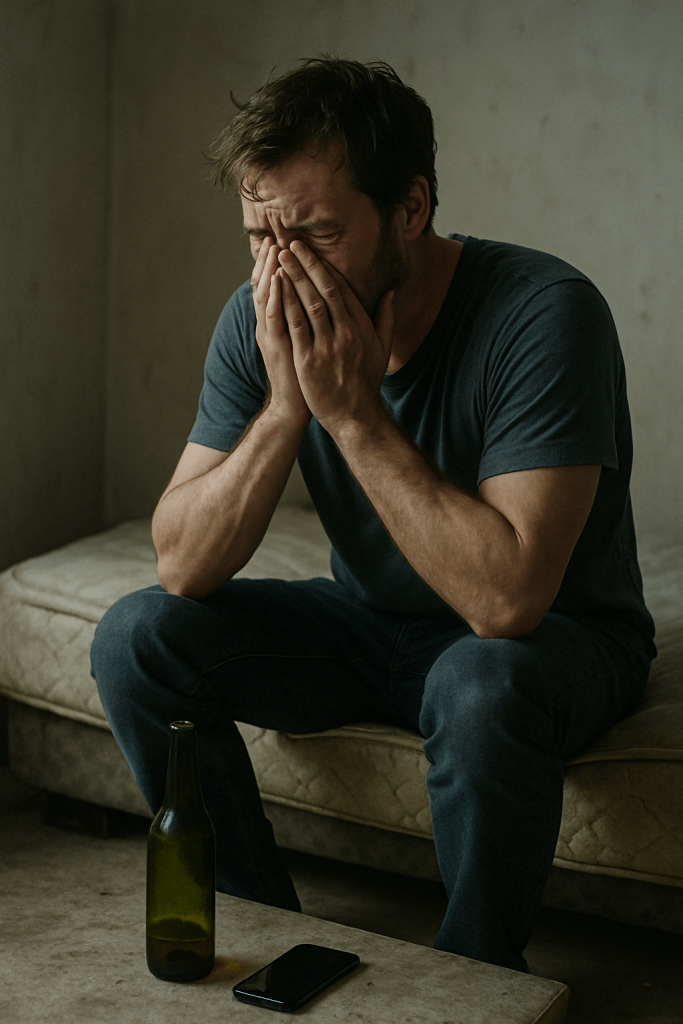
The morning was gray, the kind that doesn’t care whether you exist or not. Owen sat on the edge of his mattress—no sheets, just a bare, stained foam pad—and stared at the half-empty bottle on the floor. He didn’t remember opening it. He didn’t remember much of anything after the third beer last night, except the vague sound of glass breaking and the look of disappointment in his sister’s eyes when she’d come to check on him two weeks ago.
His phone was dead. His bank account was probably overdrawn again. His head throbbed like it had a heartbeat of its own. But something different stirred inside him—a quiet, aching awareness. He wasn’t scared. He wasn’t angry. He was tired. More than tired. He felt hollowed out.
This time, he didn’t reach for the bottle. He just sat in the silence, listening to the hum of the refrigerator and the occasional bark of a dog down the street. And then, like a whisper in the back of his mind, a sentence rose up:
“You don’t have to die this way.”
He stood slowly, knees stiff, and shuffled into the bathroom. The mirror hadn’t been cleaned in months, but he could still see his reflection clearly enough: bloodshot eyes, patchy beard, the slack jaw of someone who hadn’t smiled in a while.
He picked up his phone and plugged it in. No texts. No missed calls. He scrolled through old messages and stopped on one from his sister, Emily:
“Let me know when you’re ready. No judgment. Just love.”
For the first time in a long time, he cried.
That afternoon, Owen called a detox center. The woman on the line didn’t sound shocked or judgmental. She sounded like she’d heard his story before—maybe not his exact version, but close enough. She told him there was a bed available, and he could check in the next morning. He almost backed out, but something held him there.
That night, he didn’t drink. He curled up under an old blanket, cold and shaking, and stared at the ceiling. Every hour felt like a lifetime, but he made it to sunrise.
Detox was ugly.
His body rebelled—sweats, tremors, nausea, anxiety that felt like an iron grip around his throat. The nurses gave him medication, the staff kept him talking, and slowly, the fog began to lift. Day by day, hour by hour.
On the fifth day, someone brought in a speaker and played soft music while the group sat in silence. One man, maybe sixty, with tattooed hands and eyes that had seen everything, looked at Owen and said, “The first time I got sober, I was 22. The last time, I was 58. Took me a while to listen.”
That stuck with Owen. He didn’t want to be 58 getting sober for the tenth time. He wanted this time to mean something.
He started going to meetings. He hated the idea at first—people sitting in a circle talking about feelings? Not for him. But the first time he heard someone share honestly about relapse, about guilt, about waking up and hating yourself, he felt something he hadn’t felt in years: belonging.
They weren’t preaching. They were surviving. Together.
His sponsor, Malcolm, was a wiry man with a sharp sense of humor and a deep sense of calm. He didn’t offer advice unless asked. Mostly, he listened. When Owen ranted about his past, his failures, the people he’d hurt, Malcolm would nod and say, “And you’re still here. So what are you going to do with that?”
Owen built a new routine. Mornings started with black coffee and a walk to the park. He started journaling—just a few lines at first, then whole pages. He avoided bars, old friends, and the temptation to “just have one.” He deleted numbers. Blocked contacts. Moved apartments.
He started cooking again. Simple things: eggs, rice, lentils. Somehow, the act of feeding himself felt like reclaiming something lost.
His sister came to visit. They sat on the couch and watched reruns of old sitcoms. She didn’t say much. She didn’t need to. Just being there was enough.
Ninety days passed.
Owen celebrated his sobriety birthday with a small cupcake and a quiet moment of gratitude. No parties. No speeches. Just stillness and a deep, anchored breath.
He began volunteering at the center where he’d detoxed. At first, just sweeping floors or making coffee. But sometimes, a newcomer would arrive, eyes wide and broken, and Owen would say, “I know. I’ve been there too.”
There were still hard days.
Nights when cravings came roaring out of nowhere. Dreams that felt too real. Shame that crept back in like a cold draft under a door.
But there was also laughter. And music. And the slow, steady rebuilding of trust—with others, and with himself.
He started painting again. Nothing fancy—just color and shape and texture. Expression without expectation. Each canvas a small victory.
One year sober.
Owen stood on the same street he used to stumble down drunk, hands in his pockets, looking at the city with new eyes. The world hadn’t changed. But he had.
He smiled.
Not because life was perfect. But because he was finally living it.
Final Note:
Owen’s story isn’t rare. It echoes through rehab centers, recovery circles, and quiet homes where people fight battles no one sees. Sobriety is not a single moment. It’s a series of choices—sometimes minute by minute—that form a life you can be proud of.
No one gets it perfectly. But every step forward matters.
You don’t have to die this way.
You can live differently.
 Sincere Community Business Blog