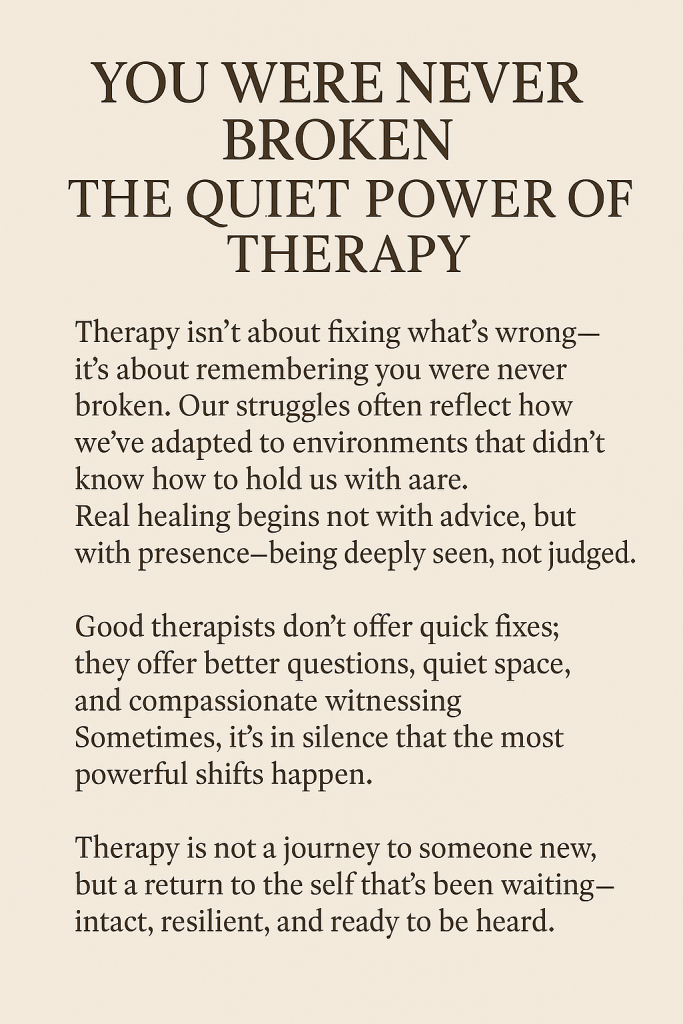
Therapy is often misunderstood as a process of fixing something defective—of correcting a “problem” in the individual. Yet this model reflects a broader cultural narrative that equates worth with perfection and emotional distress with dysfunction. In truth, therapy is not about fixing what’s wrong; it’s about remembering that you were never broken. Rather than being inherently flawed, many of our struggles are adaptive responses to environments that failed to meet our emotional needs. The power of therapy lies not in offering answers or advice, but in creating a relational space where presence, witnessing, and silence can bring what was once unspeakable into the light.
Adaptation, Not Defect
At the heart of many therapeutic approaches is the recognition that emotional suffering is often a result of adaptation, not defect. Early relationships, particularly those with caregivers, shape how we experience ourselves and others. According to attachment theory, when children grow up in environments that are neglectful, chaotic, or emotionally unavailable, they develop coping strategies—such as emotional suppression, hyper-vigilance, or dissociation—not because they are broken, but because these strategies increase their chances of survival (Bowlby, 1988).
As adults, these same strategies may appear as anxiety, depression, difficulty trusting others, or feeling chronically “not enough.” Yet these patterns are not evidence of personal failure—they are relics of a nervous system that did its best under challenging conditions. Trauma researcher Bessel van der Kolk (2014) reinforces this in The Body Keeps the Score, writing: “Trauma is not the story of something that happened back then, it’s the current imprint of that pain, horror, and fear living inside people.”
Understanding this reframes therapy as a process of compassion, not correction. Clients are not broken people in need of fixing; they are survivors in need of safe connection.
Therapy as Presence and Witnessing
Much of the healing that occurs in therapy stems not from techniques or tools, but from the therapist’s ability to be fully present. Carl Rogers, a pioneer of humanistic psychology, identified three core conditions that foster growth in therapy: empathy, congruence, and unconditional positive regard (Rogers, 1957). These are not skills in the traditional sense—they are qualities of presence that communicate, “You are safe, you are worthy, and you are seen.”
Therapists who embody these qualities do not rush to fix the client’s pain or offer prescriptive solutions. Instead, they witness. They stay. And in doing so, they create the very kind of relationship that may have been missing in the client’s early life. As Daniel Siegel (2010) explains in The Developing Mind, the human brain is shaped by relationships. Being “seen” by another—in the deepest, nonjudgmental sense—facilitates integration between different parts of the self and enables emotional regulation.
When a therapist holds space in this way, it becomes possible for clients to express grief, rage, shame, and longing—often for the first time. The process of being heard and held in those feelings, rather than being pathologized or dismissed, is itself deeply reparative.
Asking Better Questions
Contrary to popular belief, therapy is not about giving answers—it’s about helping people ask better questions. These questions don’t come from a place of diagnosis or judgment; they come from curiosity and care. A good therapist might ask, “What part of you learned to stay silent?” or “What would it mean to listen to that pain instead of pushing it away?”
These kinds of questions are rooted in the understanding that healing is not linear and that insight is not always immediate. Rather than pointing clients toward a predetermined outcome, such questions open space for exploration and self-discovery. As Irvin Yalom (2002) notes in The Gift of Therapy, “The therapist is not a mechanic, but a fellow traveler.” This shift from “fixer” to “fellow traveler” redefines the therapeutic relationship as a collaborative journey, not a hierarchical intervention.
The Healing Power of Silence
One of the most profound tools in therapy is silence. In everyday life, silence is often avoided or filled with noise—literal and emotional—because it feels uncomfortable or vulnerable. But in therapy, silence is sacred. It is the moment when something deeper begins to speak.
Psychodynamic and trauma-informed therapies both recognize the importance of allowing space for what is unspoken. As D.W. Winnicott (1960) described in his work on the “holding environment,” the therapist’s capacity to sit in silence without judgment or anxiety enables the client to access previously disowned parts of themselves. This silence is not empty; it is full of presence. It says, “I am with you, even here.”
In trauma recovery, where words may have once failed or been dangerous, the ability to sit in safe, non-intrusive silence can be revolutionary. Judith Herman (1997), in Trauma and Recovery, writes: “Recovery can take place only within the context of relationships; it cannot occur in isolation.” Silence, when shared in safety, becomes a bridge between isolation and connection.
Returning to the Self
Therapy is not a journey toward becoming someone new—it is a return to the self that has always been there, beneath the defenses, the fear, and the shame. This perspective aligns with many spiritual and humanistic traditions, which view healing not as transformation into something different, but as a reclamation of what is innately whole.
In Internal Family Systems therapy, for example, there is the core belief that within each person exists a Self that is calm, compassionate, curious, and connected (Schwartz, 2001). The work of therapy, then, is not to construct this Self, but to unburden the parts of us that have taken on extreme roles to protect us.
By the end of therapy—or rather, at each moment along the way—the goal is not to “be fixed” but to be in relationship with oneself in a new way: with kindness, patience, and reverence for the complexity of one’s story.
Conclusion
Therapy, when practiced with depth and integrity, is not a medical fix but a relational invitation. It doesn’t label people as broken or aim to “correct” their symptoms. Instead, it honors the intelligence of the body, the resilience of the psyche, and the sacredness of being seen. Through presence, better questions, compassionate witnessing, and healing silence, therapy becomes a return to wholeness.
In this return, we remember what was never truly lost: our capacity to feel, to connect, and to be fully human—intact, resilient, and ready to be heard.
References
Bowlby, J. (1988). A Secure Base: Parent-Child Attachment and Healthy Human Development. Basic Books.
Herman, J. L. (1997). Trauma and Recovery: The Aftermath of Violence—From Domestic Abuse to Political Terror.
Basic Books. Rogers, C. R. (1957). The necessary and sufficient conditions of therapeutic personality change. Journal of Consulting Psychology, 21(2), 95–103.
Schwartz, R. C. (2001). Internal Family Systems Therapy. Guilford Press. Siegel, D. J. (2010). The Developing Mind: How Relationships and the Brain Interact to Shape Who We Are. Guilford Press.
Van der Kolk, B. (2014). The Body Keeps the Score: Brain, Mind, and Body in the Healing of Trauma. Viking.
Winnicott, D. W. (1960). The theory of the parent-infant relationship. International Journal of Psychoanalysis, 41, 585–595.
Yalom, I. D. (2002). The Gift of Therapy: An Open Letter to a New Generation of Therapists and Their Patients. Harper Perennial.

