🌱 Philosophy Today & The Sincere Community

Philosophy today isn’t locked in old books.
It’s in the breath you take when you slow down.
It’s in the question: “Am I living true to myself?”

The sincere community grows from that same soil.
It’s not about perfection, but about honesty.
It’s a gathering of people who say:
• Let us be clear.
• Let us be kind.
• Let us live without masks.

In a noisy world, sincerity is rebellion.
It is saying no to the rush,
and yes to presence.

Philosophy is not just theory;
it’s choosing clean food,
quiet mornings,
art made from the heart.
It’s moving the body in balance,
finding stillness in motion.

The sincere community is where philosophy becomes daily practice:
• a detox meal as a meditation,
• a Tai Chi flow as an inquiry into balance,
• an art prompt as a dialogue with the self.

We return to simple truths:

“The greatest wealth is health.” – Virgil
“What you seek is seeking you.” – Rumi

Philosophy today is not about answers.
It’s about courage.
It’s about asking again,
in sincerity:
What kind of life do I want to live?

And the sincere community replies,
together:
Let us live with clarity, with compassion, with strength.
Let us be well. Let us be whole.


#philosophytoday #sincerecommunity

Philosophy Today and the Sincere Community
Philosophy has always been the practice of asking questions that matter: What is a good life? What do we value? How should we live together? In ancient marketplaces, philosophers stood in public squares engaging citizens in dialogue about truth, justice, and virtue. Today, the “marketplace” is no longer just the square or the academy — it is digital, global, and fast. In such a world, philosophy is not an abstract luxury; it is a living necessity. It helps us slow down, think clearly, and live intentionally in an age of distraction.

The sincere community is rooted in this same impulse. It is an answer to the fragmentation of modern life — a call to bring people back to honesty, presence, and care. To be sincere is not simply to tell the truth, but to embody it: to live without pretense, to act in ways aligned with one’s values, and to cultivate a space where others can do the same. In this sense, sincerity is itself a philosophical practice. It insists on coherence between thought and action, between inner life and outward behaviour.

Philosophy today often faces the charge of irrelevance. Many imagine it locked away in universities, speaking in technical language to small circles of specialists. But there is another current of philosophy — one that flows into everyday life, community practice, and wellness. When a person chooses to meditate, to cleanse their body, to make art, or to reflect on their values, they are doing something deeply philosophical: they are questioning what it means to live well. The sincere community honors this. It is not about abstract speculation divorced from life, but about embodied wisdom, lived renewal, and collective growth.

In this sense, philosophy today is not only about the old texts of Plato, Lao Tzu, or Marcus Aurelius, though their voices still guide us. It is also about creative experiments in living. Digital detox, auricular therapy, mindful movement, and artistic expression are not just health practices — they are philosophical acts. They affirm that well-being is not measured by accumulation or distraction, but by clarity, balance, and presence. They echo the Stoic reminder that wealth lies not in what we possess, but in how we cultivate our soul.

The sincere community seeks to be a new kind of philosophical gathering. Instead of debating in amphitheaters, members engage through shared rituals of care, storytelling, and creativity. Instead of abstract doctrines, there are daily practices — mindful eating, Tai Chi flows, art-making prompts — that become vehicles for reflection. Each detox menu, each ear point, each breath becomes a philosophical statement: I choose to live with awareness. I choose to align myself with health, harmony, and sincerity.

Philosophy today must be lived, not just studied. The sincere community shows that the deepest wisdom is not found in distant theories but in present action. To live sincerely is to live philosophically: with courage, clarity, and compassion, in a world that urgently needs all three.
#philosophytoday #sincerecommunity

Age, sexuality and coded speech: language, censorship, and Tor communities

Age, sexuality and coded speech: language, censorship, and Tor communities

1. Age & Sexuality in Language

Cultural framing – The way age and sexuality are described is heavily shaped by laws, norms, and taboos. Words that are neutral in one context may be stigmatized in another. Queer linguistics – LGBTQ+ communities often develop coded or reclaimed language (“queercoding,” “polari,” “drag slang”) to talk about sexuality in ways that resist censorship or policing. Generational shifts – Younger generations tend to use more fluid, less binary descriptors (“bi-curious,” “pansexual,” “aspec”), while older generations may lean on more fixed labels. Legal boundaries – Discussions about age and sexuality must navigate legal frameworks like age of consent laws, which vary by country. Language can therefore signal compliance or resistance.

2. Tor and Anonymity

Private discourse – Tor allows users to access the “dark web” and anonymise communication, which can be essential for discussing sexuality in repressive regimes. Safe spaces – Queer and marginalised youth may use Tor hidden services to connect without fear of outing or persecution. Risks – The same privacy protections can also be exploited for harmful purposes, so communities on Tor often create their own moderation norms.

3. Anti-Censorship & Digital Activism

Circumventing keyword bans – Activists may develop euphemisms, metaphors, or coded imagery to bypass state or platform censorship on topics like sexuality education or age-related rights. Cultural preservation – In places where queer literature or sexual health information is banned, Tor can act as an underground archive. Symbolic language – Instead of direct sexual terms, imagery, poetry, or allegory can carry layered meanings that slip past automated filters.

4. Intersections & Ethical Tensions

Youth protection vs. free speech – Anti-censorship advocates often debate how to protect minors from exploitation while still ensuring access to accurate sexuality information. Empowerment through anonymity – For people exploring identity (e.g., sexuality, gender) in restrictive environments, anonymous speech is a lifeline. Language evolution under pressure – In censored spaces, slang and symbols can evolve rapidly, creating a linguistic cat-and-mouse game between communities and censors.

Marginalised sexualities have long relied on linguistic creativity to survive, organise, and connect when open expression was dangerous or illegal. From portside cant to modern “algospeak,” communities have invented words, symbols and behaviors that communicate meaning to insiders while remaining obscure to authorities or hostile publics. This essay traces a timeline of those shifts under censorship pressures, gives examples of coded queer language, and examines how Tor and other anonymity tools shape LGBTQ+ community norms today.

Timeline: language shifts under censorship pressures

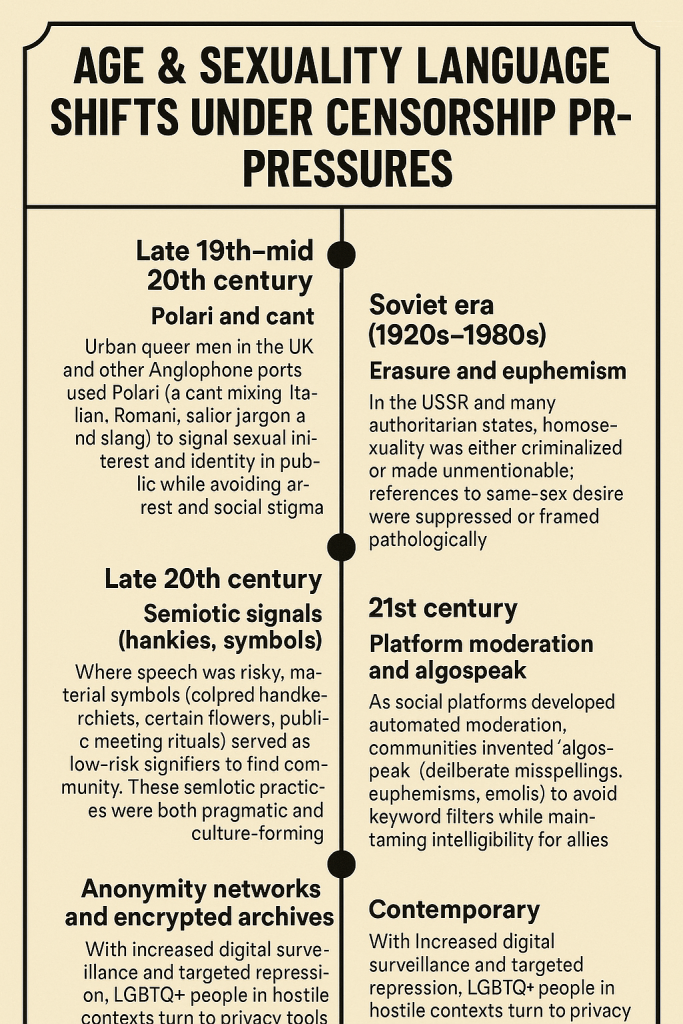
Late 19th–mid 20th century — Polari and cant: Urban queer men in the UK and other Anglophone ports used Polari (a cant mixing Italian, Romani, sailor jargon and slang) to signal sexual interest and identity in public while avoiding arrest and social stigma. Polari was prominent in public gay scenes until the 1960s–70s, when decriminalisation and mainstream visibility reduced its practical necessity.  Soviet era (1920s–1980s) — erasure and euphemism: In the USSR and many authoritarian states, homosexuality was either criminalised or made unmentionable; references to same‑sex desire were suppressed or framed pathologically. This produced euphemistic, clinical or moralising language in official discourse and drove survivors to covert idioms and private networks.  Late 20th century — semiotic signals (hankies, symbols): Where speech was risky, material symbols (colored handkerchiefs, certain flowers, public meeting rituals) served as low‑risk signifiers to find community. These semiotic practices were both pragmatic and culture‑forming.  21st century — platform moderation and algospeak: As social platforms developed automated moderation, communities invented “algospeak” (deliberate misspellings, euphemisms, emojis) to avoid keyword filters while maintaining intelligibility for allies. This is visible across TikTok, Twitter and other platforms.  Contemporary — anonymity networks and encrypted archives: With increased digital surveillance and targeted repression, LGBTQ+ people in hostile contexts turn to privacy tools (VPNs, Tor) and hidden archives to access information, mutual aid and community safely. Organisations and the Tor Project explicitly connect anonymity to LGBTQ+ human rights. 

Examples of coded queer language that emerged from repression

Polari vocabulary: Words such as “vada” (to see), “bona” (good) and “dolly” (attractive person) allowed gay men to flirt and narrate relationships in public without explicit disclosure. Polari operated as both a social badge and a safety device in times of criminalisation.  Material codes and signals: The hanky code, certain flower‑giving conventions or dress cues functioned as low‑visibility markers to indicate preferences or availability. Such semiotic systems are classic responses to prohibitive legal and social environments.  Algospeak and deliberate obfuscation (modern): On heavily moderated platforms, creators use orthographic tricks (e.g., “g@y”, “grlfr1end”), emoji substitution, and community‑understood hashtags to avoid removal while preserving meaning for insiders. Studies show algospeak is a widespread strategy to contest platform censorship.  Dogwhistles and coded hate/defensive speech: Research into computational detection of dogwhistles reveals that both hostile actors and marginalised groups use coded language to avoid detection — the effect depends on intent and context, but it demonstrates how language can hide meaning from automated systems. 

Analysis: Tor‑based LGBTQ+ community norms

Anonymity networks such as Tor alter community norms in three main ways — safety, moderation, and archival practice.

First, safety and access. Tor reduces identifiable metadata and routing visibility, enabling people in repressive jurisdictions to access sexual‑health resources, literature, and peer support that would otherwise be blocked or dangerous to view. The Tor Project frames internet freedom as inseparable from LGBTQIA+ rights; privacy tools thus function as harm‑reduction and rights‑protection infrastructure. 

Second, community governance and moderation. Unlike mainstream platforms that use centralised automated moderation, many Tor‑hidden communities rely on consensual norms, reputation, and community moderators. This can produce tighter trust networks, but it also creates tradeoffs: lack of centralised oversight sometimes enables harmful actors, while heavy anonymity complicates accountability. Empirical analyses of Tor use show the network’s user base is diverse and that only a minority of traffic is for clearly malicious ends, but community self‑policing remains crucial. 

Third, linguistic practice and archives. On Tor and in encrypted channels, language becomes less about evading public algorithms and more about preventing human identification. This shifts coded language from surface obfuscation (misspellings, emojis) to encryption and compartmentalised signifiers understood only by those with appropriate keys or community membership. Academic and civil‑society research warns that identification technologies (data mining, facial recognition, orientation inference) make privacy tools essential for survival; accordingly, hidden services and encrypted archives serve as both living spaces and cultural repositories for censored queer expression. 

Tensions and ethical considerations

There is an unavoidable tension between protecting minors and countering exploitation on the one hand, and ensuring adults in repressive contexts can access truthful sexual‑health education and community on the other. Policymakers and platforms must avoid blunt content takedowns that disproportionately silence marginalised voices; civil society argues for nuanced moderation, user empowerment and safer, privacy‑preserving access to information. 

Conclusion

Coded language has been — and remains — a pragmatic, creative response to censorship. From Polari in portside cafés to algospeak on TikTok and encrypted communities on Tor, LGBTQ+ people continuously adapt how they speak, signal and archive identity. In a world of automated filters and state surveillance, anonymity tools are not just technical utilities but social infrastructures that shape norms of trust, moderation and memory. Protecting these infrastructures, while simultaneously developing ethical moderation and harm‑reduction practices, is essential to preserving both safety and free expression for sexual minorities.

References

Baker, J.P. (n.d.) Polari: The Lost Language of Gay Men. Lancaster University. Paul Baker, Linguistics and English Language, Lancaster University https://www.lancaster.ac.uk/staff/bakerjp/polari/home.htm?utm_source=chatgpt.com

Cornwall Pride (n.d.) ‘The evolution of Polari: a hidden language unveiled’. The Evolution of Polari: A Hidden Language Unveiled – Cornwall Pride https://cornwallpride.org/organisation/articles/the-evolution-of-polari-a-hidden-language-unveiled

Mitchinson, T.G. (2016) The Censorship of Queer Art and Life Under Stalin and Beyond (PDF). University of Michigan. https://deepblue.lib.umich.edu/bitstream/handle/2027.42/120609/tgmitch.pdf?isAllo=&utm_source=chatgpt.com

Tor Project (2021) ‘Internet Freedom, Privacy, & LGBTQIA+ Human Rights’ (Tor Blog). Internet Freedom, Privacy, & LGBTQIA+ Human Rights | The Tor Project https://blog.torproject.org/privacy-lgbtqia-human-rights/?utm_source=chatgpt.com

Tor Project (n.d.) ‘Pride and Privacy’ (Tor Blog). Pride and Privacy | The Tor Project https://blog.torproject.org/pride-and-privacy/?

Fanucci, B. (2023) ‘Exploring the secret history of queer coded language’, GCN.ie. Exploring the secret history of queer coded language • GCN https://gcn.ie/exploring-queer-coded-language/

Ribeiro, M. et al. (2023) ‘From Dogwhistles to Bullhorns: Unveiling Coded Rhetoric…’ (ACL preprint). https://juliamendelsohn.github.io/assets/pdf/acl_dogwhistles_2023.pdf?utm_source=chatgpt.com

Quantitative/Platform study (2023) ‘You Can (Not) Say What You Want: Using Algospeak to Contest and …’ Social Media + Society. You Can (Not) Say What You Want: Using Algospeak to Contest and Evade Algorithmic Content Moderation on TikTok – Ella Steen, Kathryn Yurechko, Daniel Klug, 2023 https://journals.sagepub.com/doi/full/10.1177/20563051231194586?utm_source=chatgpt.com

Data & Society (2018) ‘AI Systems and Research Revealing Sexual Orientation: Case Study’ (PDF). https://datasociety.net/wp-content/uploads/2018/09/AI-Systems-and-Research-Revealing-Sexual-Orientation_Case-Study_Final.pdf?utm_source=chatgpt.com

EDRi (2019) ‘The digital rights of LGBTQ+ people: When technology reinforces societal oppressions.’ The digital rights of LGBTQ+ people: When technology reinforces societal oppressions – European Digital Rights (EDRi) https://edri.org/our-work/the-digital-rights-lgbtq-technology-reinforces-societal-oppressions/

Wired (2013) ‘For Tor, Publicity a Mixed Blessing’. For Tor, Publicity a Mixed Blessing | WIRED https://www.wired.com/2013/12/tor-publicity-

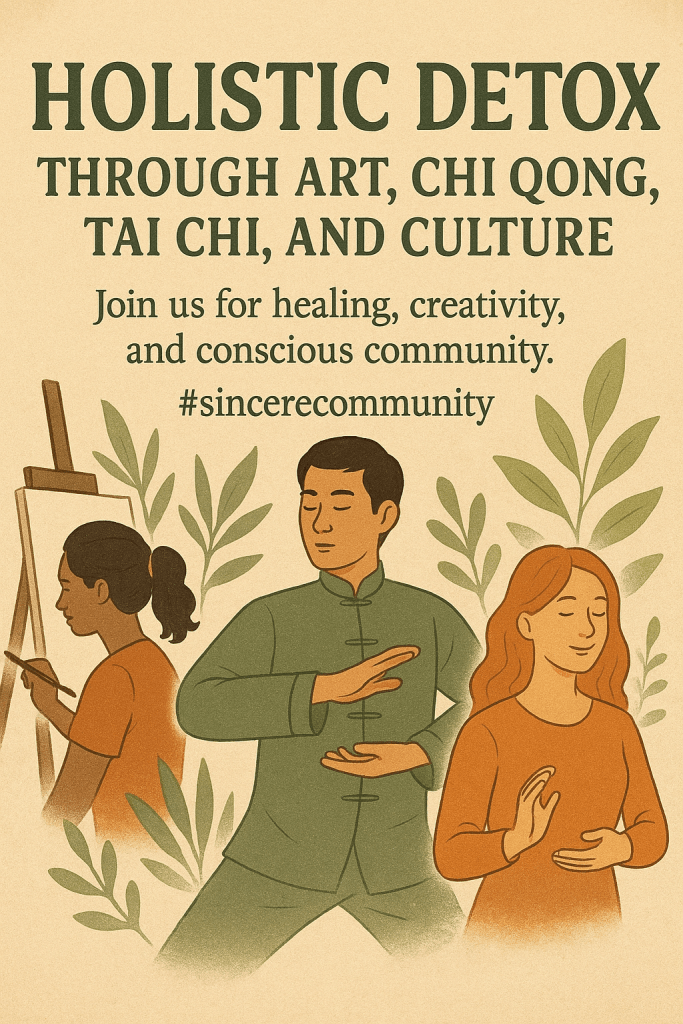
Holistic Detox Through Art, Chi Qong, Tai Chi, and Culture

Holistic Detox Through Art, Chi Qong, Tai Chi, and Culture

Join Us for Healing, Creativity, and Conscious Community

In a world of constant noise, endless scrolling, and the quiet ache of disconnection, many of us feel a pull toward something simpler, more nourishing, more human. The body craves balance, the mind seeks calm, and the heart longs for meaning. At Sincere Community, we believe the path to this kind of deep renewal lies at the crossroads of holistic wellness, creative expression, and cultural connection.

Our approach is not just about “detox” in the trendy, surface-level sense of the word. We go deeper. We understand detox as a process of releasing what no longer serves us—physically, mentally, emotionally, and culturally—and inviting in practices, experiences, and relationships that help us feel whole again. To achieve this, we weave together four powerful threads: art, Chi Qong, Tai Chi, and cultural renewal. Together, they form a tapestry of healing that is at once ancient and contemporary, individual and communal.

Art as a Pathway to Inner Cleansing

Art has always been medicine. Long before modern science began to measure its effects, humans turned to painting, music, dance, and storytelling to make sense of life’s changes, to mark transitions, and to heal wounds both seen and unseen. In our programs, art is not about perfection or technical skill—it’s about process. We create safe, open spaces where you can explore without judgment, play with materials, and express the stories your body has been holding onto.

We might invite you to paint while listening to live music, to create collaborative murals with fellow participants, or to write poetry inspired by the rhythms of your breath. These creative acts are not distractions from “real life”—they are essential tools for detoxifying the mind, releasing stress, and reawakening joy. Art becomes a mirror, reflecting your inner landscape and showing you new possibilities for how you can live, think, and connect.

Chi Qong: Moving Energy, Restoring Flow

Where art works on the imagination and emotions, Chi Qong works directly with your body’s energy systems. Rooted in thousands of years of Chinese medicine and philosophy, Chi Qong uses slow, intentional movements, breath work, and mindful awareness to unblock stagnant energy and restore flow throughout the body.

In the context of detox, Chi Qong is especially powerful. It stimulates the lymphatic system, enhances circulation, and supports the body’s natural detoxification pathways. But beyond the physical benefits, Chi Qong helps you release tension, calm the mind, and cultivate a sense of grounded presence.

Our Chi Qong sessions are accessible to all levels. We begin with gentle warm-ups, then guide you through flowing sequences designed to harmonize breath and movement. As you practice, you’ll notice a subtle but profound shift—your awareness expanding, your breath deepening, and your mind quieting into a meditative state.

Tai Chi: The Dance of Balance

While Chi Qong emphasises the cultivation and circulation of energy, Tai Chi extends those principles into a moving meditation, often called “the dance of balance.” It’s a martial art, but not in the sense of combat—it’s a practice of attunement, grace, and internal strength.

Each Tai Chi form is a sequence of movements that flow seamlessly into one another, like water shifting in a stream. Practicing Tai Chi strengthens muscles, improves posture, and enhances coordination, but perhaps its greatest gift is balance—both physically and mentally.

For those on a holistic detox journey, balance is key. As you release toxins, old habits, and outdated patterns, you need practices that help you remain steady, centered, and connected to yourself. Tai Chi teaches patience, persistence, and the art of moving through life with calm confidence.

Culture as the Heart of Community Healing

Many wellness programs focus solely on the individual—your body, your mind, your diet. While these are essential, we believe healing also happens in the cultural field we share with others. Culture shapes how we see ourselves, how we relate, and how we find meaning. That’s why our programs incorporate cultural renewal as a core pillar.

This might take the form of community storytelling circles, where participants share their histories, traditions, and dreams. It could mean cooking and eating together using nourishing, seasonal foods, or hosting performances that blend music, poetry, and movement from different cultural traditions.

Cultural connection reminds us that we’re part of something larger—that our healing is woven into the collective well-being of our community. It’s a detox from isolation, division, and cultural amnesia, replaced by a sense of belonging, respect, and shared creativity.

The Sincere Community Experience

When you join Sincere Community, you step into a space where all four threads—art, Chi Qong, Tai Chi, and culture—are integrated into a seamless, living experience. A typical day might begin with gentle Chi Qong under the morning sun, followed by a Tai Chi sequence that grounds you in your body. Midday might bring a creative workshop where you explore visual art, music, or writing, followed by a shared meal prepared with seasonal, detox-supportive ingredients. The evening could end with a cultural gathering—storytelling, live music, or a collaborative performance—designed to nourish not just the individual, but the group as a whole.

We believe in cycles of activity and rest, of inward reflection and outward sharing. Our spaces are intentionally designed to be restorative—free from the constant pull of screens and noise—so you can reconnect with your own rhythms and with the rhythms of nature.

Why This Matters Now

The modern world demands constant output and attention, but rarely offers the conditions for true renewal. We live in bodies that are overworked, in minds that are overstimulated, and in societies that are undernourished when it comes to genuine connection. Holistic detox, as we see it, is not a luxury—it’s a necessity.

Art gives us the tools to reimagine ourselves. Chi Qong and Tai Chi give us the practices to rebalance our energy and strength. Cultural connection gives us the belonging we need to sustain our growth. Together, they form a pathway not just for personal healing, but for the kind of community transformation the world sorely needs.

An Invitation

We invite you to join us—not as a consumer of a wellness product, but as a co-creator of a living, breathing, healing culture. Bring your curiosity, your stories, your body, your voice. Whether you are seeking to clear away the stress of modern life, to explore your creative potential, or to reconnect with community, you’ll find a place here.

At Sincere Community, holistic detox is not a week-long challenge or a fleeting trend—it’s a practice, a gathering, and a movement. Together, we can create spaces where healing is natural, creativity is celebrated, and connection is conscious.

Let’s breathe together, move together, create together. Let’s remember what it feels like to be fully alive.

#sincerecommunity

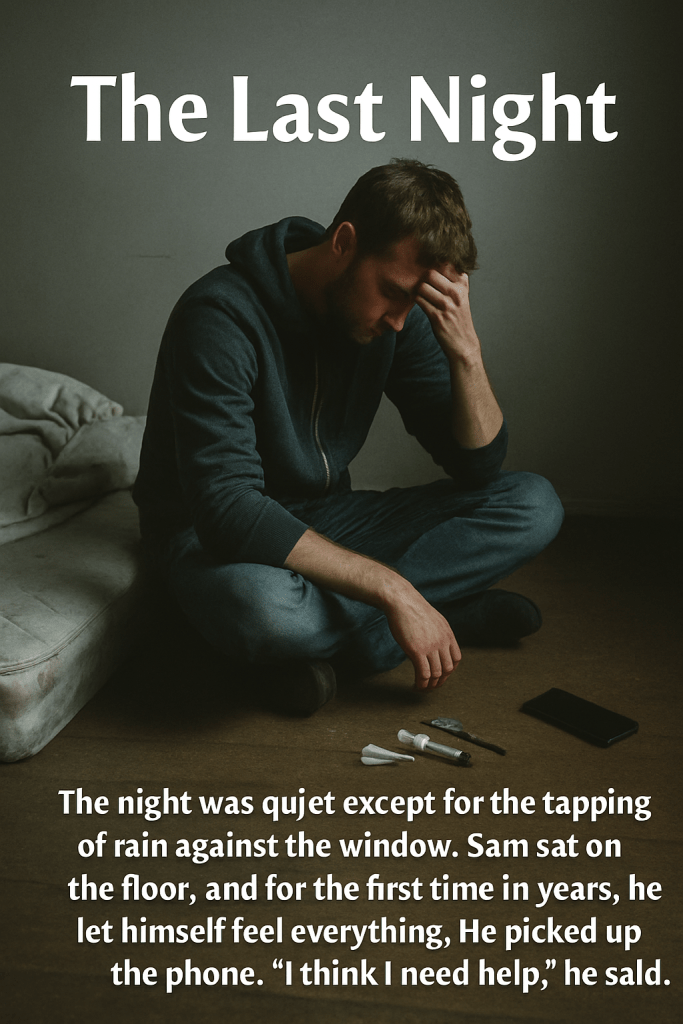
“The Last Night” – A Short Story About Quitting Drugs

“The Last Night” – A Short Story About Quitting Drugs

~1000 words

The night was quiet except for the tapping of rain against the window. Sam sat cross-legged on the stained carpet, his back against the couch. In front of him, on the coffee table, lay the usual: a lighter, a bent spoon, and a few things he told himself he could throw away tomorrow.

He told himself that a lot.

His hands were trembling, but not from withdrawal this time. Something deeper was moving in him. A thought that had been growing louder for weeks: I can’t do this anymore.

He picked up the phone. It had been months since he called his mother. She answered on the second ring, her voice careful, like she was afraid to hope.

“Sam?”

“It’s me,” he said, voice cracked. “I think I need help.”

That night, he didn’t use. He didn’t sleep either. His body screamed for it—restless legs, pounding heartbeat, chills that came and went. But for the first time in years, he let himself feel all of it.

In the pale blue of early morning, he stuffed what he could into a backpack: a hoodie, a water bottle, an old photo of him and his sister before everything fell apart. He took one last look at the table, then swept everything into the trash.

Detox was worse than he imagined.

The first day, he thought about leaving. The second day, he begged the nurse for more medication. By the third, he was curled into himself on the bed, drenched in sweat, convinced he was going to die.

He didn’t die.

On the fifth day, he woke to sunlight streaming through the blinds. His body still ached, but something was different. His mind, though cloudy, felt lighter.

That afternoon, he sat in a group circle. People shared their stories—lost jobs, broken marriages, jail time, near-deaths. Every story was different, but every feeling was the same. He wasn’t alone.

When he left detox, the real work began.

He started going to NA meetings. At first, he sat in the back, arms crossed, telling himself he didn’t belong. But people remembered his name. They asked him how he was doing. They didn’t judge the gaps in his teeth, the track marks, the way he avoided eye contact.

His sponsor, an older guy named Luis, had been clean for eight years. He told Sam, “We can’t change the past, but we can keep it from becoming our future.”

The days weren’t easy.

There were mornings he woke up and the first thing he thought about was using. There were nights when loneliness sat heavy in his chest and he wondered if it would ever go away. But there were also small wins—making it through the week without a craving crushing him, cooking a meal, laughing with someone without being high.

He found work at a local coffee shop. It wasn’t glamorous, but it gave him purpose. He started jogging before sunrise, the air sharp in his lungs. He learned how to be bored without needing to escape it.

Three months clean, he saw his sister for the first time in years. She stood in the doorway, eyes wet, before hugging him so tightly it almost hurt.

“I’m proud of you,” she whispered.

Six months clean, he got his own small apartment—nothing fancy, but it was his. He hung the photo of him and his sister above the kitchen table.

A year after his last high, Sam sat in the same NA meeting where he’d first spoken. His hands didn’t shake when he stood up.

“My name’s Sam,” he said, “and I’m an addict.”

The room echoed back, “Hi, Sam.”

He told them about the night he called his mom. About the trash bag filled with the last of his supply. About detox. About how recovery wasn’t magic—it was work, messy and slow, but worth it.

When he sat down, a newcomer caught his eye. Young, pale, eyes darting around like a cornered animal. Sam gave him a nod. The kind that says, I see you. I’ve been there. You can make it out too.

Final Note:

Quitting drugs is not a single heroic moment—it’s a hundred small, stubborn choices to keep going when it’s hard, and to believe in a life you haven’t yet lived. For Sam, it began with a phone call and a sleepless night. For someone else, it might be today.

Change You Are, Too

🌱 New Research Now on ResearchGate

What happens when we redefine change as the move from harm to goodness, from irony to trust?

In my latest research, I explore how fear, control, obedience, and ideals interact with the narrative frameworks that either suppress or enable transformation. Irony—so often dismissed—emerges as a tool for confronting neglect and reclaiming agency. We often overlook how the smallest shifts in tone or tradition can block or enable meaningful progress.

🌀 Change is not just something you observe.

Change is something you are, too.

When harm becomes healing, when trust replaces fraud, the change is not only external—it transforms the self.

Read now:

📖 Fear Control Change 2 (ResearchGate)

📖 Fear and Control: Change (ResearchGate)

#fear #control #change #science #narrative #trust #healing #research #youaretoo

If you’re dealing with a situation where assurances or indemnities have been undermined due to the tenant being a vulnerable adult

If you’re dealing with a situation where assurances or indemnities have been undermined due to the tenant being a vulnerable adult

If you’re dealing with a situation where assurances or indemnities have been undermined due to the tenant being a vulnerable adult, here’s a breakdown of what might be happening and what to consider legally and ethically:

⸻

✅ Key Concepts:

  1. Cheating Indemnity of Assurances

This phrase likely refers to:
• Breaking or evading promises (assurances)
• Dodging financial/legal responsibility (indemnity)
• Potential deception or bad faith actions (cheating)

  1. Vulnerable Adult

A vulnerable adult is typically someone:
• With a mental or physical disability, age-related conditions, or cognitive impairment
• Who may be unable to fully understand, consent to, or enforce contractual terms

⸻

⚖️ Legal & Ethical Concerns

🔹 Capacity to Contract
• If the tenant lacks legal capacity, any contracts or indemnity clauses may not be enforceable.
• Landlords or letting agents must ensure informed consent was given.

🔹 Duty of Care
• Landlords have a heightened duty of care toward vulnerable tenants.
• Evading responsibilities by exploiting a tenant’s vulnerability could be deemed unfair practice or even discriminatory.

🔹 Unfair Terms / Consumer Protection
• Under the Consumer Rights Act 2015 (UK) or similar consumer legislation elsewhere, terms that are:
• Not transparent,
• Imposed without understanding,
• Or exploit vulnerability
…could be unfair and unenforceable.

🔹 Safeguarding Violations
• If an assurance was made (e.g. about repairs, safety, or support) and was intentionally broken, it could be seen as neglect or exploitation under adult safeguarding law.

📋 Example Situations

Scenario
Legal Concern
Landlord promised repairs but never completed them, knowing tenant has dementia
Potential neglect or breach of tenancy obligations
A “guarantee” was signed by a vulnerable adult under pressure
Potential invalid contract due to lack of informed consent
Tenant’s vulnerability is used to avoid paying damages or compensation
May constitute bad faith conduct or abuse of power

🛠️ Remedies / Next Steps
1. Safeguarding Referral
• If exploitation or abuse is suspected, report to Adult Social Services or a safeguarding board.
2. Legal Advice
• Consult a solicitor or advocacy service—especially one specializing in housing law or mental capacity law.
3. Ombudsman / Housing Regulator
• If it’s a housing association or social landlord, file a complaint with the Housing Ombudsman.
4. Mental Capacity Assessment
• If capacity is in question, seek a formal assessment via health or social care services.
5. Support via Advocacy
• Organizations like MIND, Age UK, or Shelter (UK) offer support for vulnerable tenants.

⸻

📘 Suggested Wording (if writing a complaint or legal letter):

“We believe the indemnity assurances given to our client, a vulnerable adult, have been disregarded, amounting to a breach of trust and potential exploitation. We request an immediate review of the agreement and consideration for the tenant’s protected status under consumer and safeguarding law.”

“The Day the Fog Lifted” – A Short Story About Sobriety

“The Day the Fog Lifted” – A Short Story About Sobriety

~1000 words

The morning was gray, the kind that doesn’t care whether you exist or not. Owen sat on the edge of his mattress—no sheets, just a bare, stained foam pad—and stared at the half-empty bottle on the floor. He didn’t remember opening it. He didn’t remember much of anything after the third beer last night, except the vague sound of glass breaking and the look of disappointment in his sister’s eyes when she’d come to check on him two weeks ago.

His phone was dead. His bank account was probably overdrawn again. His head throbbed like it had a heartbeat of its own. But something different stirred inside him—a quiet, aching awareness. He wasn’t scared. He wasn’t angry. He was tired. More than tired. He felt hollowed out.

This time, he didn’t reach for the bottle. He just sat in the silence, listening to the hum of the refrigerator and the occasional bark of a dog down the street. And then, like a whisper in the back of his mind, a sentence rose up:

“You don’t have to die this way.”

He stood slowly, knees stiff, and shuffled into the bathroom. The mirror hadn’t been cleaned in months, but he could still see his reflection clearly enough: bloodshot eyes, patchy beard, the slack jaw of someone who hadn’t smiled in a while.

He picked up his phone and plugged it in. No texts. No missed calls. He scrolled through old messages and stopped on one from his sister, Emily:

“Let me know when you’re ready. No judgment. Just love.”

For the first time in a long time, he cried.

That afternoon, Owen called a detox center. The woman on the line didn’t sound shocked or judgmental. She sounded like she’d heard his story before—maybe not his exact version, but close enough. She told him there was a bed available, and he could check in the next morning. He almost backed out, but something held him there.

That night, he didn’t drink. He curled up under an old blanket, cold and shaking, and stared at the ceiling. Every hour felt like a lifetime, but he made it to sunrise.

Detox was ugly.

His body rebelled—sweats, tremors, nausea, anxiety that felt like an iron grip around his throat. The nurses gave him medication, the staff kept him talking, and slowly, the fog began to lift. Day by day, hour by hour.

On the fifth day, someone brought in a speaker and played soft music while the group sat in silence. One man, maybe sixty, with tattooed hands and eyes that had seen everything, looked at Owen and said, “The first time I got sober, I was 22. The last time, I was 58. Took me a while to listen.”

That stuck with Owen. He didn’t want to be 58 getting sober for the tenth time. He wanted this time to mean something.

He started going to meetings. He hated the idea at first—people sitting in a circle talking about feelings? Not for him. But the first time he heard someone share honestly about relapse, about guilt, about waking up and hating yourself, he felt something he hadn’t felt in years: belonging.

They weren’t preaching. They were surviving. Together.

His sponsor, Malcolm, was a wiry man with a sharp sense of humor and a deep sense of calm. He didn’t offer advice unless asked. Mostly, he listened. When Owen ranted about his past, his failures, the people he’d hurt, Malcolm would nod and say, “And you’re still here. So what are you going to do with that?”

Owen built a new routine. Mornings started with black coffee and a walk to the park. He started journaling—just a few lines at first, then whole pages. He avoided bars, old friends, and the temptation to “just have one.” He deleted numbers. Blocked contacts. Moved apartments.

He started cooking again. Simple things: eggs, rice, lentils. Somehow, the act of feeding himself felt like reclaiming something lost.

His sister came to visit. They sat on the couch and watched reruns of old sitcoms. She didn’t say much. She didn’t need to. Just being there was enough.

Ninety days passed.

Owen celebrated his sobriety birthday with a small cupcake and a quiet moment of gratitude. No parties. No speeches. Just stillness and a deep, anchored breath.

He began volunteering at the center where he’d detoxed. At first, just sweeping floors or making coffee. But sometimes, a newcomer would arrive, eyes wide and broken, and Owen would say, “I know. I’ve been there too.”

There were still hard days.

Nights when cravings came roaring out of nowhere. Dreams that felt too real. Shame that crept back in like a cold draft under a door.

But there was also laughter. And music. And the slow, steady rebuilding of trust—with others, and with himself.

He started painting again. Nothing fancy—just color and shape and texture. Expression without expectation. Each canvas a small victory.

One year sober.

Owen stood on the same street he used to stumble down drunk, hands in his pockets, looking at the city with new eyes. The world hadn’t changed. But he had.

He smiled.

Not because life was perfect. But because he was finally living it.

Final Note:

Owen’s story isn’t rare. It echoes through rehab centers, recovery circles, and quiet homes where people fight battles no one sees. Sobriety is not a single moment. It’s a series of choices—sometimes minute by minute—that form a life you can be proud of.

No one gets it perfectly. But every step forward matters.

You don’t have to die this way.

You can live differently.

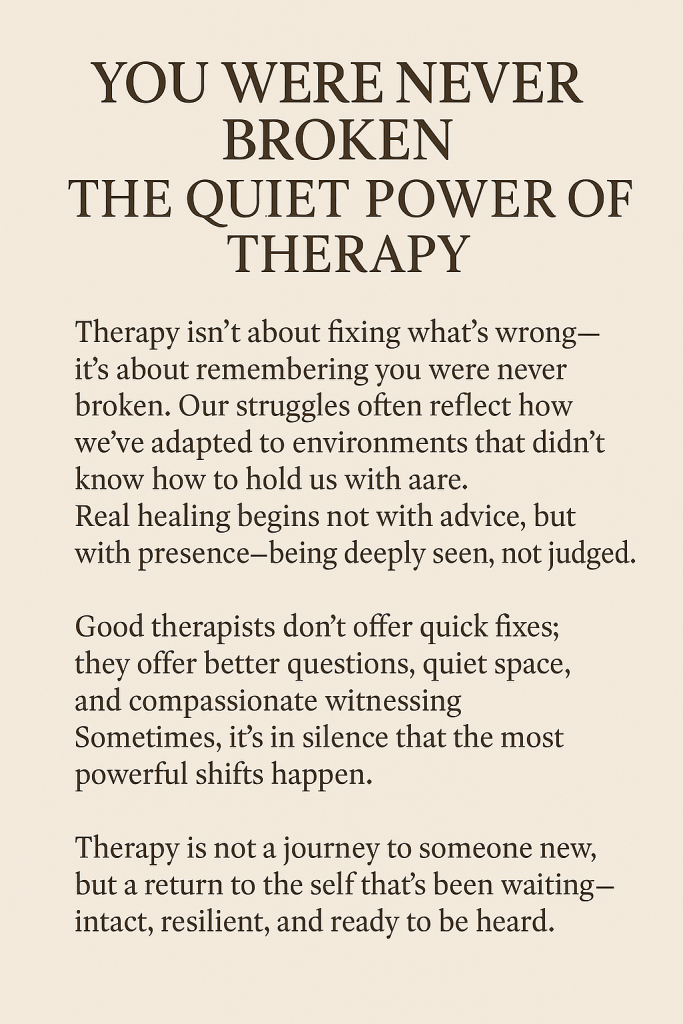
You Were Never Broken: The Quiet Power of Therapy

You Were Never Broken: The Quiet Power of Therapy

Therapy is often misunderstood as a process of fixing something defective—of correcting a “problem” in the individual. Yet this model reflects a broader cultural narrative that equates worth with perfection and emotional distress with dysfunction. In truth, therapy is not about fixing what’s wrong; it’s about remembering that you were never broken. Rather than being inherently flawed, many of our struggles are adaptive responses to environments that failed to meet our emotional needs. The power of therapy lies not in offering answers or advice, but in creating a relational space where presence, witnessing, and silence can bring what was once unspeakable into the light.

Adaptation, Not Defect

At the heart of many therapeutic approaches is the recognition that emotional suffering is often a result of adaptation, not defect. Early relationships, particularly those with caregivers, shape how we experience ourselves and others. According to attachment theory, when children grow up in environments that are neglectful, chaotic, or emotionally unavailable, they develop coping strategies—such as emotional suppression, hyper-vigilance, or dissociation—not because they are broken, but because these strategies increase their chances of survival (Bowlby, 1988).

As adults, these same strategies may appear as anxiety, depression, difficulty trusting others, or feeling chronically “not enough.” Yet these patterns are not evidence of personal failure—they are relics of a nervous system that did its best under challenging conditions. Trauma researcher Bessel van der Kolk (2014) reinforces this in The Body Keeps the Score, writing: “Trauma is not the story of something that happened back then, it’s the current imprint of that pain, horror, and fear living inside people.”

Understanding this reframes therapy as a process of compassion, not correction. Clients are not broken people in need of fixing; they are survivors in need of safe connection.

Therapy as Presence and Witnessing

Much of the healing that occurs in therapy stems not from techniques or tools, but from the therapist’s ability to be fully present. Carl Rogers, a pioneer of humanistic psychology, identified three core conditions that foster growth in therapy: empathy, congruence, and unconditional positive regard (Rogers, 1957). These are not skills in the traditional sense—they are qualities of presence that communicate, “You are safe, you are worthy, and you are seen.”

Therapists who embody these qualities do not rush to fix the client’s pain or offer prescriptive solutions. Instead, they witness. They stay. And in doing so, they create the very kind of relationship that may have been missing in the client’s early life. As Daniel Siegel (2010) explains in The Developing Mind, the human brain is shaped by relationships. Being “seen” by another—in the deepest, nonjudgmental sense—facilitates integration between different parts of the self and enables emotional regulation.

When a therapist holds space in this way, it becomes possible for clients to express grief, rage, shame, and longing—often for the first time. The process of being heard and held in those feelings, rather than being pathologized or dismissed, is itself deeply reparative.

Asking Better Questions

Contrary to popular belief, therapy is not about giving answers—it’s about helping people ask better questions. These questions don’t come from a place of diagnosis or judgment; they come from curiosity and care. A good therapist might ask, “What part of you learned to stay silent?” or “What would it mean to listen to that pain instead of pushing it away?”

These kinds of questions are rooted in the understanding that healing is not linear and that insight is not always immediate. Rather than pointing clients toward a predetermined outcome, such questions open space for exploration and self-discovery. As Irvin Yalom (2002) notes in The Gift of Therapy, “The therapist is not a mechanic, but a fellow traveler.” This shift from “fixer” to “fellow traveler” redefines the therapeutic relationship as a collaborative journey, not a hierarchical intervention.

The Healing Power of Silence

One of the most profound tools in therapy is silence. In everyday life, silence is often avoided or filled with noise—literal and emotional—because it feels uncomfortable or vulnerable. But in therapy, silence is sacred. It is the moment when something deeper begins to speak.

Psychodynamic and trauma-informed therapies both recognize the importance of allowing space for what is unspoken. As D.W. Winnicott (1960) described in his work on the “holding environment,” the therapist’s capacity to sit in silence without judgment or anxiety enables the client to access previously disowned parts of themselves. This silence is not empty; it is full of presence. It says, “I am with you, even here.”

In trauma recovery, where words may have once failed or been dangerous, the ability to sit in safe, non-intrusive silence can be revolutionary. Judith Herman (1997), in Trauma and Recovery, writes: “Recovery can take place only within the context of relationships; it cannot occur in isolation.” Silence, when shared in safety, becomes a bridge between isolation and connection.

Returning to the Self

Therapy is not a journey toward becoming someone new—it is a return to the self that has always been there, beneath the defenses, the fear, and the shame. This perspective aligns with many spiritual and humanistic traditions, which view healing not as transformation into something different, but as a reclamation of what is innately whole.

In Internal Family Systems therapy, for example, there is the core belief that within each person exists a Self that is calm, compassionate, curious, and connected (Schwartz, 2001). The work of therapy, then, is not to construct this Self, but to unburden the parts of us that have taken on extreme roles to protect us.

By the end of therapy—or rather, at each moment along the way—the goal is not to “be fixed” but to be in relationship with oneself in a new way: with kindness, patience, and reverence for the complexity of one’s story.

Conclusion

Therapy, when practiced with depth and integrity, is not a medical fix but a relational invitation. It doesn’t label people as broken or aim to “correct” their symptoms. Instead, it honors the intelligence of the body, the resilience of the psyche, and the sacredness of being seen. Through presence, better questions, compassionate witnessing, and healing silence, therapy becomes a return to wholeness.

In this return, we remember what was never truly lost: our capacity to feel, to connect, and to be fully human—intact, resilient, and ready to be heard.

References

Bowlby, J. (1988). A Secure Base: Parent-Child Attachment and Healthy Human Development. Basic Books.

Herman, J. L. (1997). Trauma and Recovery: The Aftermath of Violence—From Domestic Abuse to Political Terror.

Basic Books. Rogers, C. R. (1957). The necessary and sufficient conditions of therapeutic personality change. Journal of Consulting Psychology, 21(2), 95–103.

Schwartz, R. C. (2001). Internal Family Systems Therapy. Guilford Press. Siegel, D. J. (2010). The Developing Mind: How Relationships and the Brain Interact to Shape Who We Are. Guilford Press.

Van der Kolk, B. (2014). The Body Keeps the Score: Brain, Mind, and Body in the Healing of Trauma. Viking.

Winnicott, D. W. (1960). The theory of the parent-infant relationship. International Journal of Psychoanalysis, 41, 585–595.

Yalom, I. D. (2002). The Gift of Therapy: An Open Letter to a New Generation of Therapists and Their Patients. Harper Perennial.

Cognitive Behavioural Therapy (CBT) and Core Counselling Skills: A Practical Introduction

Cognitive Behavioural Therapy (CBT) and Core Counselling Skills: A Practical Introduction

Introduction

Cognitive Behavioural Therapy (CBT) is one of the most widely applied and empirically supported psychotherapeutic models used in counselling practice today. Rooted in both cognitive and behavioural psychology, CBT aims to help individuals recognise and change unhelpful thought patterns and behaviours. As part of core counselling skills training, CBT offers a practical framework for understanding the interrelation between thoughts, emotions, physical sensations, and behaviours. This essay provides an introductory overview of the theory behind CBT, explores its use in client-centred therapy, and discusses how its techniques align with and enhance foundational counselling skills. The inclusion of Rational Emotive Behaviour Therapy (REBT), a precursor to CBT, further broadens the understanding of its cognitive principles.

Understanding the Foundations of CBT

CBT is built on the premise that psychological distress is often maintained by distorted or irrational thoughts. These thoughts can affect how we feel physically and emotionally, and in turn, influence our behaviours. According to CBT theory, by identifying and restructuring these maladaptive thoughts, individuals can bring about emotional and behavioural change.

In my publication Cognitive Behavioural Therapy (CBT) Method Theory, I detail how CBT works by breaking down problems into five interconnected domains:

Situations Thoughts Emotions Physical sensations Behaviours These areas interact continuously, creating feedback loops that can either reinforce wellbeing or perpetuate distress (CBT Method Theory).

The approach is future-focused and structured, encouraging clients to take an active role in identifying problems and working toward solutions. This makes CBT a highly empowering model for clients, aligning well with ethical counselling practice that centres client autonomy and self-determination.

The Role of Rational Emotive Behaviour Therapy (REBT)

CBT owes much of its foundation to Rational Emotive Behaviour Therapy (REBT), developed by Albert Ellis. REBT posits that our emotional responses are not directly caused by external events but rather by the beliefs we hold about those events. The key therapeutic goal is to help individuals identify irrational beliefs, dispute them, and replace them with more rational alternatives.

As discussed in my CBT method publication, REBT helps clients “identify, confront, and replace self-defeating behaviours” (CBT Method Theory). This process enables clients to move from unhealthy, automatic reactions to more considered, adaptive responses. These ideas form the cognitive core of many modern CBT protocols.

CBT in Counselling: Theory into Practice

CBT is particularly valuable in core counselling skills training because it provides both a structured approach and the flexibility to adapt to individual client needs. A typical CBT session will involve collaborative agenda setting, problem identification, and the use of evidence-based techniques such as:

Cognitive restructuring Thought records Behavioural experiments Graded exposure Socratic questioning

These techniques promote mindful awareness of how thoughts impact feelings and actions. The emphasis on practical tools and measurable progress gives CBT strong appeal in both clinical and community counselling settings.

In this context, CBT fosters clarity and comfort—two central goals of therapy as discussed in Therapy – A Vital Concept (Therapy – A Vital Concept). Therapy must be adaptable and responsive, and CBT’s structured flexibility allows it to be customised across different presentations, including depression, anxiety, PTSD, and even behavioural addictions.

Therapeutic Purpose and Client Empowerment

The therapeutic purpose of CBT goes beyond symptom reduction. It fosters the internalisation of new, self-generated patterns of thought and behaviour, gradually leading to self-regulation, resilience, and personal development. As noted in Therapy – A Vital Concept, therapy serves as a transformative space where clients build “automatic, self-imposed positive ideas, attitudes, and behaviours” that counteract earlier maladaptive patterns.

Unlike approaches that focus heavily on past experiences, CBT helps clients focus on present cognition and behaviour. It reframes personal challenges as problems that can be solved with logic, structure, and commitment. This fosters a sense of agency and purpose, making therapy not just curative but constructive.

Unpacking Personal Growth through CBT

CBT promotes personal growth through the deliberate cultivation of rational self-understanding and behavioural accountability. Clients are encouraged to explore:

Why they think the way they do How their beliefs affect their reactions How to actively reshape unhelpful patterns

This process leads to enhanced self-awareness, emotional intelligence, and decision-making capacity—all of which are integral components of mental wellness and growth.

In my publication Personal Growth, I discuss how therapeutic engagement can foster long-term developmental change, particularly when clients internalise healthier mental frameworks (Personal Growth). CBT complements this goal by offering immediate tools to help individuals track and adjust how they think and behave, leading to enhanced clarity, comfort, and capability in everyday life.

Counselling Skills Supported by CBT

Core counselling skills such as active listening, empathic reflection, goal-setting, and feedback are central to the CBT process. For example:

Empathic listening helps validate the client’s emotional experience. Socratic questioning helps clients explore and challenge assumptions. Behavioural activation uses goal-setting and planning to reduce depressive symptoms.

CBT therapists must balance these technical skills with humanistic qualities such as unconditional positive regard, which ensures clients feel respected and safe. Although CBT is directive at times, it is always rooted in a collaborative alliance, where therapist and client work together to identify goals and measure progress.

CBT in Broader Social and Cultural Contexts

CBT is also adaptable across cultural and socio-economic backgrounds. Its focus on real-world application, self-efficacy, and measurable change makes it effective in group therapy, schools, community programs, and digital platforms. This aligns with the Sincere Community vision of offering therapy that is socially responsive and culturally renewing.

CBT supports mental wellness not just at the individual level but at the community level—helping people develop skills to navigate stress, build resilience, and act with intention in a world full of noise and distraction.

Conclusion

Cognitive Behavioural Therapy (CBT) is an essential tool in the counsellor’s skillset, combining the rigour of psychological science with the empathy of human connection. Its structured yet flexible model provides both a theoretical and practical foundation for therapeutic work, particularly in the context of core counselling skills development. With contributions from REBT, CBT encourages clients to challenge limiting beliefs, reframe harmful thoughts, and engage in constructive behaviours that lead to personal transformation.

As emphasised across my ResearchGate publications—CBT Method Theory, Therapy – A Vital Concept, and Personal Growth—CBT aligns with the deeper goals of counselling: to empower, clarify, and support lasting growth. In a time when mental wellness is more important than ever, CBT stands as a powerful, accessible, and respectful method of guiding individuals toward greater self-awareness, emotional resilience, and holistic wellbeing.

References

Kembery, F. (2022). Cognitive Behavioural Therapy (CBT) Method Theory. ResearchGate. https://www.researchgate.net/publication/364699959_Cognitive_Behavioural_Therapy_CBT_Method_Theorypdf

Kembery, F. (2022). Therapy – A Vital Concept. ResearchGate. https://www.researchgate.net/publication/364698689_Therapy_-_A_Vital_Conceptpdf

Kembery, F. (2022). Personal Growth. ResearchGate. https://www.researchgate.net/publication/364699428_Personal_Growthpdf

Psychodynamic Counselling: Core Concepts and Therapeutic Application

Psychodynamic Counselling: Core Concepts and Therapeutic Application

Introduction

Psychodynamic counselling is one of the foundational theoretical frameworks in psychotherapy, originating from the pioneering work of Sigmund Freud and further developed by theorists like Carl Jung, Melanie Klein, and Object Relations psychologists. It provides a structured yet deep exploration into the unconscious processes that govern human behaviour. Within the scope of core counselling skills training, the psychodynamic approach offers profound insights into the development of personality, the origins of emotional conflict, and the mechanisms of psychological defence. This essay provides a brief introduction to the psychodynamic model, explores its key theoretical components, and discusses how these concepts support personal growth and therapeutic outcomes when applied in counselling practice.

Core Concepts of the Psychodynamic Model

The psychodynamic model revolves around the dynamic interplay between different levels of consciousness—namely, the conscious, preconscious, and unconscious—and how unresolved inner conflicts from early life experiences shape present behaviour. Freud proposed that the mind is divided into three key structures: the id, ego, and superego.

The Id represents the primal, instinctual part of the psyche, driven by urges and desires, primarily seeking pleasure without moral considerations. The Ego is the rational mediator that balances the demands of the id with the constraints of the external world and the moral pressures of the superego. The Superego is the internalised moral compass, often in conflict with the desires of the id, which can produce guilt, anxiety, or shame when its standards are violated.

Freud believed that much of our behaviour is governed by unconscious motivations. His famous dictum—“to make the unconscious conscious”—summarises the fundamental aim of psychodynamic therapy: to bring hidden thoughts, memories, and conflicts into conscious awareness where they can be examined and resolved.

In my publication Psychodynamic Method Theory, I summarise these elements and emphasise their relevance in modern counselling contexts, particularly for those learning core counselling skills (Psychodynamic Method Theory).

Mechanisms of Defence and Projection

A major feature of psychodynamic therapy is the understanding of defence mechanisms—unconscious strategies the ego employs to reduce anxiety arising from internal conflict. These defences can be adaptive in the short term but become problematic when they distort reality or hinder personal growth. Common examples include repression, denial, displacement, and projection.

Projection, for instance, occurs when individuals attribute their unacceptable feelings to someone else. For example, if a person has unconscious hostility toward someone, they might unconsciously believe that the other person is hostile toward them. This is particularly significant in counselling sessions, where clients may displace unresolved emotions onto the therapist, a phenomenon known as transference.

Recognising and working with these defences is an essential skill in psychodynamic counselling. The counsellor must remain non-judgmental while gently helping clients to become aware of these patterns. The goal is not to eliminate defences but to help clients understand their function and origins so they can make healthier, more conscious choices.

The Collective Unconscious: Jung’s Contribution

While Freud focused on the individual unconscious, Carl Jung introduced the concept of the collective unconscious, which includes universal archetypes and shared psychological patterns inherited from humanity’s collective experience. Jung believed that healing involves integrating these archetypal elements and achieving psychological individuation, a process of becoming one’s true self.

In psychodynamic practice, Jung’s theories offer a broader, often spiritual dimension, enabling clients to explore dreams, symbols, and life patterns through a mythic or cultural lens. This expansion of the unconscious from personal to collective enhances the depth of psychodynamic counselling and allows clients to relate their personal struggles to broader human experiences.

The Therapeutic Relationship and the Purpose of Therapy

The therapeutic alliance is central in psychodynamic therapy. It is through this relationship that unconscious processes—such as transference and countertransference—can be observed, understood, and transformed. The therapist serves not only as a guide but also as a reflective surface through which the client’s internal world can be mirrored and made conscious.

The therapeutic purpose in this model is to uncover and work through unconscious material so that clients can resolve inner conflicts and move toward greater emotional freedom. In my research Therapy – A Vital Concept, I emphasise the idea that therapy must be flexible, personal, and rooted in each client’s needs (Therapy – A Vital Concept).

The application of this principle in psychodynamic counselling means that while theory provides structure, the actual work is always guided by the evolving needs of the individual. Therapy is a co-created process, where the insights and growth emerge through reflection, emotional exploration, and relational interaction.

Personal Growth and Emotional Clarity

Ultimately, the goals of psychodynamic therapy are personal growth, emotional clarity, and inner comfort. These outcomes are not achieved through advice or direction, but through an introspective process that helps clients identify recurring life patterns, understand their roots, and develop healthier coping strategies.

In Personal Growth, I describe how individuals undergoing therapy gradually internalise more adaptive beliefs, attitudes, and behaviours, replacing those conditioned by past traumas or unmet needs (Personal Growth).

Importantly, growth in this model is not linear. Clients may revisit the same emotional themes multiple times, deepening their understanding and slowly transforming their responses. The therapist’s role is to maintain a consistent, supportive presence and help the client navigate this emotional terrain with empathy and insight.

Core Counselling Skills in Psychodynamic Practice

Training in core counselling skills enables practitioners to deliver psychodynamic therapy in a safe and effective manner. These skills include:

Active listening Reflective questioning Silence and space Emotional attunement Boundary setting

In the psychodynamic model, these skills are employed not only to understand content but to explore process—how the client communicates, relates, and repeats unconscious patterns within the session itself.

For students and early-career practitioners, psychodynamic training provides a rich foundation for understanding human complexity. It encourages deep listening, critical thinking, and self-reflection—qualities that are essential for ethical and effective counselling.

Conclusion

Psychodynamic counselling continues to be a valuable and evolving framework within therapeutic practice. Its insights into the unconscious mind, emotional conflict, and human development provide a powerful lens for understanding and supporting clients. When paired with core counselling skills, the psychodynamic approach offers a transformative journey toward greater self-awareness, emotional healing, and personal growth.

Whether working with trauma, identity, anxiety, or relationship issues, the psychodynamic method allows both therapist and client to access the deeper layers of experience that shape behaviour. It respects the complexity of the human psyche and honours the unique path each individual must walk toward wholeness.

References

Kembery, F. (2022). Psychodynamic Method Theory. ResearchGate. https://www.researchgate.net/publication/364695969_Psychodynamic_Method_Theorypdf

Kembery, F. (2022). Therapy – A Vital Concept. ResearchGate. https://www.researchgate.net/publication/364698689_Therapy_-_A_Vital_Conceptpdf

Kembery, F. (2022). Personal Growth. ResearchGate. https://www.researchgate.net/publication/364699428_Personal_Growthpdf

Design a site like this with WordPress.com
Get started