1. Age & Sexuality in Language
Cultural framing – The way age and sexuality are described is heavily shaped by laws, norms, and taboos. Words that are neutral in one context may be stigmatized in another. Queer linguistics – LGBTQ+ communities often develop coded or reclaimed language (“queercoding,” “polari,” “drag slang”) to talk about sexuality in ways that resist censorship or policing. Generational shifts – Younger generations tend to use more fluid, less binary descriptors (“bi-curious,” “pansexual,” “aspec”), while older generations may lean on more fixed labels. Legal boundaries – Discussions about age and sexuality must navigate legal frameworks like age of consent laws, which vary by country. Language can therefore signal compliance or resistance.
2. Tor and Anonymity
Private discourse – Tor allows users to access the “dark web” and anonymise communication, which can be essential for discussing sexuality in repressive regimes. Safe spaces – Queer and marginalised youth may use Tor hidden services to connect without fear of outing or persecution. Risks – The same privacy protections can also be exploited for harmful purposes, so communities on Tor often create their own moderation norms.
3. Anti-Censorship & Digital Activism
Circumventing keyword bans – Activists may develop euphemisms, metaphors, or coded imagery to bypass state or platform censorship on topics like sexuality education or age-related rights. Cultural preservation – In places where queer literature or sexual health information is banned, Tor can act as an underground archive. Symbolic language – Instead of direct sexual terms, imagery, poetry, or allegory can carry layered meanings that slip past automated filters.
4. Intersections & Ethical Tensions
Youth protection vs. free speech – Anti-censorship advocates often debate how to protect minors from exploitation while still ensuring access to accurate sexuality information. Empowerment through anonymity – For people exploring identity (e.g., sexuality, gender) in restrictive environments, anonymous speech is a lifeline. Language evolution under pressure – In censored spaces, slang and symbols can evolve rapidly, creating a linguistic cat-and-mouse game between communities and censors.
Marginalised sexualities have long relied on linguistic creativity to survive, organise, and connect when open expression was dangerous or illegal. From portside cant to modern “algospeak,” communities have invented words, symbols and behaviors that communicate meaning to insiders while remaining obscure to authorities or hostile publics. This essay traces a timeline of those shifts under censorship pressures, gives examples of coded queer language, and examines how Tor and other anonymity tools shape LGBTQ+ community norms today.
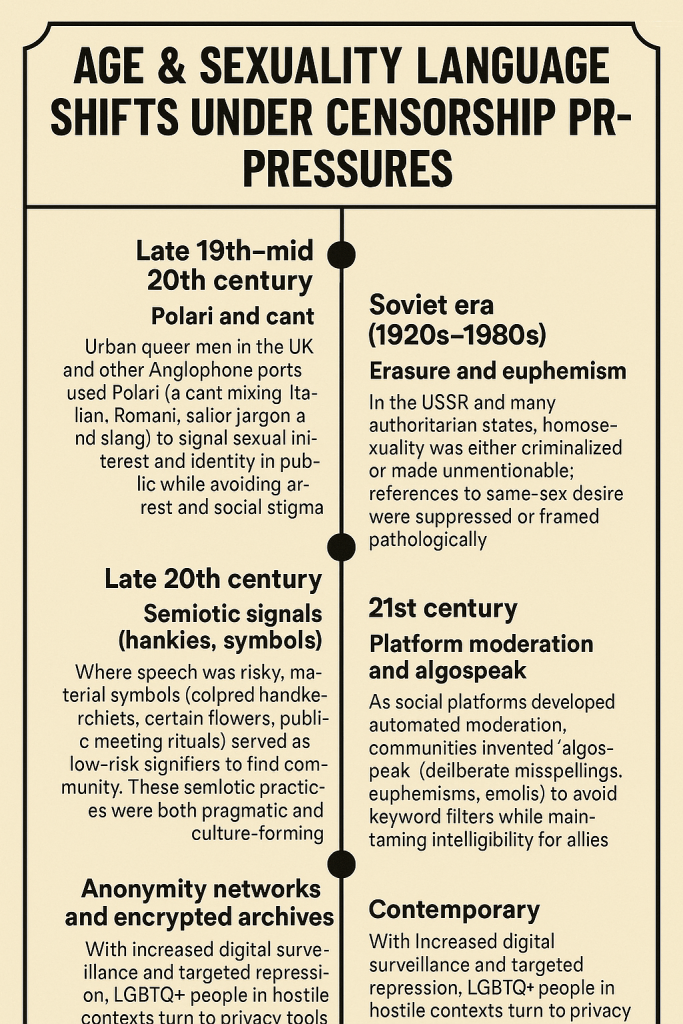
Timeline: language shifts under censorship pressures
Late 19th–mid 20th century — Polari and cant: Urban queer men in the UK and other Anglophone ports used Polari (a cant mixing Italian, Romani, sailor jargon and slang) to signal sexual interest and identity in public while avoiding arrest and social stigma. Polari was prominent in public gay scenes until the 1960s–70s, when decriminalisation and mainstream visibility reduced its practical necessity. Soviet era (1920s–1980s) — erasure and euphemism: In the USSR and many authoritarian states, homosexuality was either criminalised or made unmentionable; references to same‑sex desire were suppressed or framed pathologically. This produced euphemistic, clinical or moralising language in official discourse and drove survivors to covert idioms and private networks. Late 20th century — semiotic signals (hankies, symbols): Where speech was risky, material symbols (colored handkerchiefs, certain flowers, public meeting rituals) served as low‑risk signifiers to find community. These semiotic practices were both pragmatic and culture‑forming. 21st century — platform moderation and algospeak: As social platforms developed automated moderation, communities invented “algospeak” (deliberate misspellings, euphemisms, emojis) to avoid keyword filters while maintaining intelligibility for allies. This is visible across TikTok, Twitter and other platforms. Contemporary — anonymity networks and encrypted archives: With increased digital surveillance and targeted repression, LGBTQ+ people in hostile contexts turn to privacy tools (VPNs, Tor) and hidden archives to access information, mutual aid and community safely. Organisations and the Tor Project explicitly connect anonymity to LGBTQ+ human rights.
Examples of coded queer language that emerged from repression
Polari vocabulary: Words such as “vada” (to see), “bona” (good) and “dolly” (attractive person) allowed gay men to flirt and narrate relationships in public without explicit disclosure. Polari operated as both a social badge and a safety device in times of criminalisation. Material codes and signals: The hanky code, certain flower‑giving conventions or dress cues functioned as low‑visibility markers to indicate preferences or availability. Such semiotic systems are classic responses to prohibitive legal and social environments. Algospeak and deliberate obfuscation (modern): On heavily moderated platforms, creators use orthographic tricks (e.g., “g@y”, “grlfr1end”), emoji substitution, and community‑understood hashtags to avoid removal while preserving meaning for insiders. Studies show algospeak is a widespread strategy to contest platform censorship. Dogwhistles and coded hate/defensive speech: Research into computational detection of dogwhistles reveals that both hostile actors and marginalised groups use coded language to avoid detection — the effect depends on intent and context, but it demonstrates how language can hide meaning from automated systems.
Analysis: Tor‑based LGBTQ+ community norms
Anonymity networks such as Tor alter community norms in three main ways — safety, moderation, and archival practice.
First, safety and access. Tor reduces identifiable metadata and routing visibility, enabling people in repressive jurisdictions to access sexual‑health resources, literature, and peer support that would otherwise be blocked or dangerous to view. The Tor Project frames internet freedom as inseparable from LGBTQIA+ rights; privacy tools thus function as harm‑reduction and rights‑protection infrastructure.
Second, community governance and moderation. Unlike mainstream platforms that use centralised automated moderation, many Tor‑hidden communities rely on consensual norms, reputation, and community moderators. This can produce tighter trust networks, but it also creates tradeoffs: lack of centralised oversight sometimes enables harmful actors, while heavy anonymity complicates accountability. Empirical analyses of Tor use show the network’s user base is diverse and that only a minority of traffic is for clearly malicious ends, but community self‑policing remains crucial.
Third, linguistic practice and archives. On Tor and in encrypted channels, language becomes less about evading public algorithms and more about preventing human identification. This shifts coded language from surface obfuscation (misspellings, emojis) to encryption and compartmentalised signifiers understood only by those with appropriate keys or community membership. Academic and civil‑society research warns that identification technologies (data mining, facial recognition, orientation inference) make privacy tools essential for survival; accordingly, hidden services and encrypted archives serve as both living spaces and cultural repositories for censored queer expression.
Tensions and ethical considerations
There is an unavoidable tension between protecting minors and countering exploitation on the one hand, and ensuring adults in repressive contexts can access truthful sexual‑health education and community on the other. Policymakers and platforms must avoid blunt content takedowns that disproportionately silence marginalised voices; civil society argues for nuanced moderation, user empowerment and safer, privacy‑preserving access to information.
Conclusion
Coded language has been — and remains — a pragmatic, creative response to censorship. From Polari in portside cafés to algospeak on TikTok and encrypted communities on Tor, LGBTQ+ people continuously adapt how they speak, signal and archive identity. In a world of automated filters and state surveillance, anonymity tools are not just technical utilities but social infrastructures that shape norms of trust, moderation and memory. Protecting these infrastructures, while simultaneously developing ethical moderation and harm‑reduction practices, is essential to preserving both safety and free expression for sexual minorities.
References
Baker, J.P. (n.d.) Polari: The Lost Language of Gay Men. Lancaster University. Paul Baker, Linguistics and English Language, Lancaster University https://www.lancaster.ac.uk/staff/bakerjp/polari/home.htm?utm_source=chatgpt.com
Cornwall Pride (n.d.) ‘The evolution of Polari: a hidden language unveiled’. The Evolution of Polari: A Hidden Language Unveiled – Cornwall Pride https://cornwallpride.org/organisation/articles/the-evolution-of-polari-a-hidden-language-unveiled
Mitchinson, T.G. (2016) The Censorship of Queer Art and Life Under Stalin and Beyond (PDF). University of Michigan. https://deepblue.lib.umich.edu/bitstream/handle/2027.42/120609/tgmitch.pdf?isAllo=&utm_source=chatgpt.com
Tor Project (2021) ‘Internet Freedom, Privacy, & LGBTQIA+ Human Rights’ (Tor Blog). Internet Freedom, Privacy, & LGBTQIA+ Human Rights | The Tor Project https://blog.torproject.org/privacy-lgbtqia-human-rights/?utm_source=chatgpt.com
Tor Project (n.d.) ‘Pride and Privacy’ (Tor Blog). Pride and Privacy | The Tor Project https://blog.torproject.org/pride-and-privacy/?
Fanucci, B. (2023) ‘Exploring the secret history of queer coded language’, GCN.ie. Exploring the secret history of queer coded language • GCN https://gcn.ie/exploring-queer-coded-language/
Ribeiro, M. et al. (2023) ‘From Dogwhistles to Bullhorns: Unveiling Coded Rhetoric…’ (ACL preprint). https://juliamendelsohn.github.io/assets/pdf/acl_dogwhistles_2023.pdf?utm_source=chatgpt.com
Quantitative/Platform study (2023) ‘You Can (Not) Say What You Want: Using Algospeak to Contest and …’ Social Media + Society. You Can (Not) Say What You Want: Using Algospeak to Contest and Evade Algorithmic Content Moderation on TikTok – Ella Steen, Kathryn Yurechko, Daniel Klug, 2023 https://journals.sagepub.com/doi/full/10.1177/20563051231194586?utm_source=chatgpt.com
Data & Society (2018) ‘AI Systems and Research Revealing Sexual Orientation: Case Study’ (PDF). https://datasociety.net/wp-content/uploads/2018/09/AI-Systems-and-Research-Revealing-Sexual-Orientation_Case-Study_Final.pdf?utm_source=chatgpt.com
EDRi (2019) ‘The digital rights of LGBTQ+ people: When technology reinforces societal oppressions.’ The digital rights of LGBTQ+ people: When technology reinforces societal oppressions – European Digital Rights (EDRi) https://edri.org/our-work/the-digital-rights-lgbtq-technology-reinforces-societal-oppressions/
Wired (2013) ‘For Tor, Publicity a Mixed Blessing’. For Tor, Publicity a Mixed Blessing | WIRED https://www.wired.com/2013/12/tor-publicity-
 Sincere Community Business Blog