~1000 words
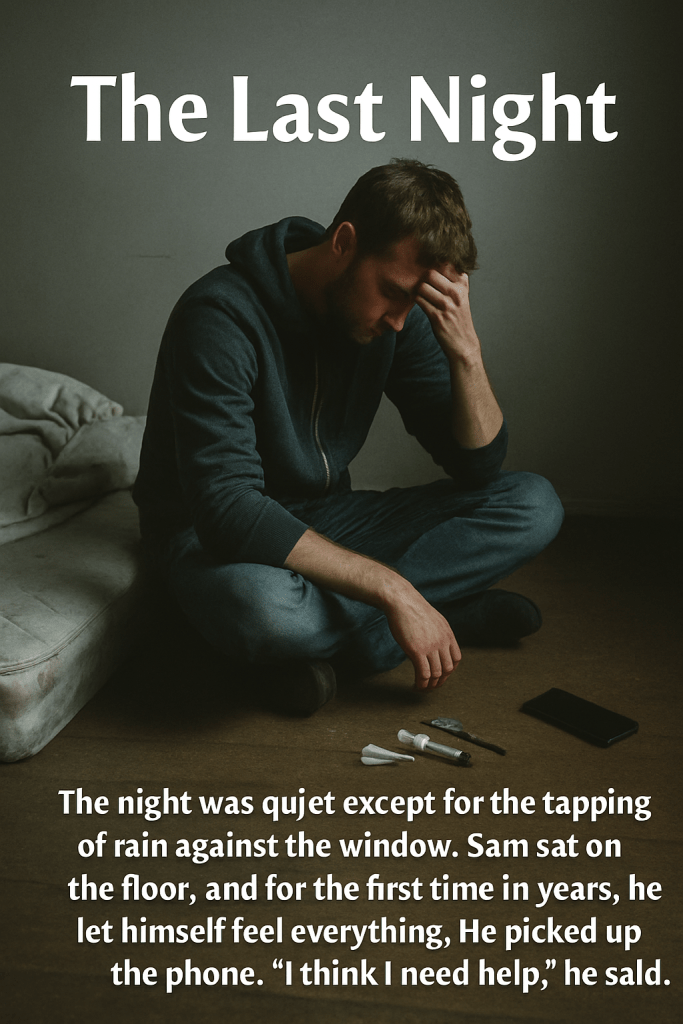
The night was quiet except for the tapping of rain against the window. Sam sat cross-legged on the stained carpet, his back against the couch. In front of him, on the coffee table, lay the usual: a lighter, a bent spoon, and a few things he told himself he could throw away tomorrow.
He told himself that a lot.
His hands were trembling, but not from withdrawal this time. Something deeper was moving in him. A thought that had been growing louder for weeks: I can’t do this anymore.
He picked up the phone. It had been months since he called his mother. She answered on the second ring, her voice careful, like she was afraid to hope.
“Sam?”
“It’s me,” he said, voice cracked. “I think I need help.”
That night, he didn’t use. He didn’t sleep either. His body screamed for it—restless legs, pounding heartbeat, chills that came and went. But for the first time in years, he let himself feel all of it.
In the pale blue of early morning, he stuffed what he could into a backpack: a hoodie, a water bottle, an old photo of him and his sister before everything fell apart. He took one last look at the table, then swept everything into the trash.
Detox was worse than he imagined.
The first day, he thought about leaving. The second day, he begged the nurse for more medication. By the third, he was curled into himself on the bed, drenched in sweat, convinced he was going to die.
He didn’t die.
On the fifth day, he woke to sunlight streaming through the blinds. His body still ached, but something was different. His mind, though cloudy, felt lighter.
That afternoon, he sat in a group circle. People shared their stories—lost jobs, broken marriages, jail time, near-deaths. Every story was different, but every feeling was the same. He wasn’t alone.
When he left detox, the real work began.
He started going to NA meetings. At first, he sat in the back, arms crossed, telling himself he didn’t belong. But people remembered his name. They asked him how he was doing. They didn’t judge the gaps in his teeth, the track marks, the way he avoided eye contact.
His sponsor, an older guy named Luis, had been clean for eight years. He told Sam, “We can’t change the past, but we can keep it from becoming our future.”
The days weren’t easy.
There were mornings he woke up and the first thing he thought about was using. There were nights when loneliness sat heavy in his chest and he wondered if it would ever go away. But there were also small wins—making it through the week without a craving crushing him, cooking a meal, laughing with someone without being high.
He found work at a local coffee shop. It wasn’t glamorous, but it gave him purpose. He started jogging before sunrise, the air sharp in his lungs. He learned how to be bored without needing to escape it.
Three months clean, he saw his sister for the first time in years. She stood in the doorway, eyes wet, before hugging him so tightly it almost hurt.
“I’m proud of you,” she whispered.
Six months clean, he got his own small apartment—nothing fancy, but it was his. He hung the photo of him and his sister above the kitchen table.
A year after his last high, Sam sat in the same NA meeting where he’d first spoken. His hands didn’t shake when he stood up.
“My name’s Sam,” he said, “and I’m an addict.”
The room echoed back, “Hi, Sam.”
He told them about the night he called his mom. About the trash bag filled with the last of his supply. About detox. About how recovery wasn’t magic—it was work, messy and slow, but worth it.
When he sat down, a newcomer caught his eye. Young, pale, eyes darting around like a cornered animal. Sam gave him a nod. The kind that says, I see you. I’ve been there. You can make it out too.
Final Note:
Quitting drugs is not a single heroic moment—it’s a hundred small, stubborn choices to keep going when it’s hard, and to believe in a life you haven’t yet lived. For Sam, it began with a phone call and a sleepless night. For someone else, it might be today.
 Sincere Community Business Blog